

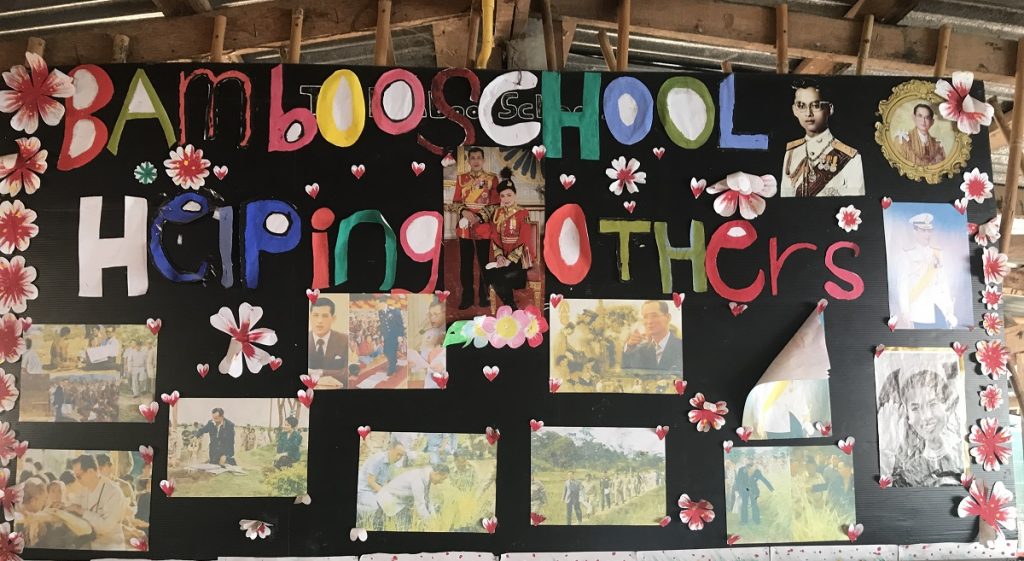
In March 2021 while on the usual supplier auditing trip to Thailand I had the opportunity to join a film crew that were heading out from Bangkok to the border of Myanmar and Thailand. They were making a documentary about a Children’s refuge that was built out of recycled plastic bottles and that was run by a New Zealand lady. It’s a long 5 hour trek to get there and the crew were going there and back in one day so I was hesitant to begin with but decided that I should not let adventures like this pass me by. I was also intrigued by how this lady had accomplished building this refuge in such a remote corner of Thailand.
The Journey
The mini van driver picked us up at 4.30am having already collected the two Cameramen and off we set on the long journey to a village near Sai Yok about 60 km west of Kanchanaburi where the River Kwai was famously bridged by the heroic British Prisoners of War in 1943.
During the journey I found out more about where we were heading and why. The Bamboo school was started about 20 years ago by a lady called Catherine Riley-Bryan who was now in her early 70’s. The school now was more of a refuge for traumatised, sick and disabled children from the tribal communities of the Shan, Karen and Mon that were caught up in the battles on their land and threatened by the Myanmar army. Tragically their parents often smuggled them over the mountainous border and abandoned them in the knowledge that their children had a high chance of being enslaved or murdered if they stayed their country.
However, the topic of the TV documentary series that this day’s filing was being used for was how different people and organisations are have a positive impact of Thailand’s environment. The Bamboo School was going to be the subject on one whole episode.
The School and refuge, I found out from Nan, the Producer, not only housed and cared for these poor children but it was mainly built out of used plastic bottles! I could not quite picture it in my head and was keen to get there are see for myself how this could be done and how the children coped with living in what surely had to be ram shackled huts built from plastic. I also learnt that Catherine, who was previously a paramedic in New Zealand, maintains 2 ambulances and is a volunteer driver for the local villagers. In case anyone has needs urgent medical treatment, she is on call 24 hours a day.
We were about 20 Km from the School, winding our way through the jungle, the driver expertly dodging the many potholes that dotted the tarmaced surface, when we saw 2 ambulances parked on the side of a road, 2 or 3 cars and some Thai police officers taking notes. We craned our heads as our driver guided us past the incident and we continued on our journey as we were getting late for our 11am meeting with Catherine.
We turned right off the “main” road on the instruction of the hand painted sign we had barely spotted on the side of the road. Then we headed up a concreted track through a dense patch of trees that was just about wide enough to accommodate the wheels of our minivan. The driver slipped down into low gear as he headed up the steep incline. Then we saw a dotting of buildings and a carport that housed 1 vehicle, a 4×4 Toyata Prado which had been converted into an ambulance. We had arrived.
Greetings
We were greeted by a young, smiley girl who welcomed us warmly and introduced herself as Dowltong. She told us the sad news that one of the villagers had burnt herself quite badly on an open fire and that Catherine had taken her to hospital early that morning in the other ambulance. She said we could go and explore the school and speak to the kids and that it was nearly lunchtime so all the kids would be gathering in the kitchen/dining room area soon.
We had a walk around the grounds, Nan directing the cameramen as to what shots and angles she required and slowly children stared to appear from the buildings. They varied in ages from toddlers to teenagers, some of the teenage girls were caring for babies that had been abandoned too, taking on the role of mother or big sister and looking after the infants.
To my amazement some of the children started speaking to me in good English! “where are you from?” “Hello Mr, what is your name?”!
4 of the children gave us a tour of their sleeping quarters. While the dormitory was humble it was nothing like what I had envisaged. There were 10 narrow beds, each with a mosquito net. There were other children in the room busy doing chores, sweeping and cleaning and changing bedding, an incredible sight to see such happy and willing children cleaning their bedrooms!

Lunch time at the children’s refuge
We heard a bell ring, it was 12pm – lunchtime. We followed the children form the dormitory up the hill outside the kitchen building they kicked off their sandals and flip flop, filed inside and formed an orderly queue, holding their dinner metal partitioned, dinner trays.
They were served at the kitchen counter by the designated chefs for that (the chefs were also students, we saw no staff). Lunch was simple but healthy looking, rice, vegetable curry and rice noodles with watermelon for pudding. The children all sat on the floor and shared their plates of food with 2 or 3 other children. The atmosphere was alive with the buzz of conversations in many different languages, Thai, Burmese, English and what we later found out was their own respective tribal languages too. Some of these kids could actually speak 4 languages!

Meeting Catherine
Towards the end of dinner time Catherine finally appeared. She said a quick hello to us but was more focused initially on making sure all the kids were ok after her unexpected departure earlier that morning.
When she had finally caught up with the children she came to introduce herself properly apologised for her delay and explained that on the way to taking the burns patient to the hospital a car had reversed out of a lane and hit her ambulance side-on while she was driving down the main road. She had had to be cut out of the drivers side door. Her ambulance was undrivable and she had to wait for another ambulance to come and collect the patient. Catherine herself had mild whiplash but was more concerned about her ambulance and if it could be fixed or not, she dismissed her pain ushered us out of the kitchen for a tour of the school! It was then that I started to realise how selfless, tough, courageous and caring this lady was.
It also had become apparent that the incident we had passed on our journey to the children’s refuge was in fact Catherine and we had witnessed the story she had just told us.
Catherine picked up a small baby called Cha-lor form the arms of another of her children and we walked down the hillside and she pointed out 2 round shaped guest huts that looked very nice and homely. They had been built for volunteers to stay and help out at the school and could house 6 people. However she explained that because of the Covid situation she had been on her own for close to 6 months now as travel restrictions had stopped the influx of international arrivals and thus her regular flow of foreign helpers had completely dried up.
So now she was relying on her children as she calls them (they all call her Momo or Mum too, all 86 of them!) to help her to take care of each other. The older ones acting as big sisters and brothers to the younger ones.

Every day is a school day, literally
We also found out that during the week the children over the age of 5 actually go to the local school which is why she had arranged for us to visit on a Sunday. As the majority of the children that arrive at The Bamboo School are from the Shan, Karen or Mon tribes they don’t have any ID cards, either for Myanmar or Thailand. Therefore they have no rights to a Thai education or medical treatment. However for the equivalent of £20 and a lot of paperwork Catherine can get them registered on the Thai system and then registered at a local school. She feels this is very important as her goal is for every child to be given the chance to better themselves and to do something with their life.
But they still learn plenty at The Bamboo school too. Catherine makes time for extra-curricular activities and they learn English. She also arranges lessons with older tribal members so that the children can still communicate in their own respective languages in case their parents or family member (if they are alive) ever get the chance to see these kids again.
She also teaches the children how to look after themselves, grow their own organic vegetables, cook, clean, good manners and to care for each other, and also, all importantly, how to build solid houses out of plastic bottles! They try to provide their own food, grown on the land they have and mainly live on a diet of freshly grown organic vegetables and fish they can catch from the adjacent lake.
When Catherine drives the ambulance, she is regularly accompanied by one of the schoolchildren. At age 12, all pupils complete Emergency First Responder courses provided by the Pittakarn Foundation, which supports the school’s ambulance service. Interested children take turns to be nominated for ambulance duty and sleep in their clothes so they’re ready to go straight away in an emergency. And the children are soon putting those skills to work measuring blood pressure, administering oxygen and dealing with bleeding.
Learning to have a future
Over 600 children have passed though The Bamboo School over the 20 years that it’s been open and most have a positive outcome, its certainly offers more than just being a children’s refuge. Many have graduated from University and continued to become doctors, nurses, teachers or translators. Some have taken less academic routes and become fishermen, mechanics or elephant workers. Some have also found love at the school and met their future spouse. Just like any other family they return to the nest on regular intervals to help with their younger “siblings” and when they can some donate back to the school to help with its development to take care of future generations. Catherine has created a very special place and has given hope, a home, encouragement, love and life to these very disadvantaged children.

The Motivation
You can see the border of Myanmar from the school, it’s a big, jungle covered mountain range. Beyond that is 2km of “no man’s land” and beyond that the war torn, military dictatorship that is decimating these local populations.
Later that day while talking to Catherine in one of the newer “air conditioned” ** round huts that also had a log fireplace! (It gets pretty cool here in the winter) she told me that one of her main motivations for doing what she does is to make amends for the impact her ancestors had on the local people. Lord Mountbatten of Burma is a distant relative of hers and when the British handed back the colony in 1948 the Treaty failed to recognise any of the tribes that inhabited the region. Ever since the people of the Shan, Mon and Karen have been left with no place or identity in the modern world. They were left in political limbo between the two countries of Thailand and Myanmar.
So Catherine’s work with The Bamboo School is partly driven by the need to make amends for what the British did in this area. Catherine is obviously a naturally caring and generous person and lives a modest life with her Thai husband who is an engineer in a small house on the land. She has dedicated her life to helping these people in both in her local Thai community and the child refugees from over the border.
Farewell
During the afternoon, we conducted many interviews with Catherine and the cameramen got a lot of footage for the TV documentary. We saw the new large building she started as she expecting a large influx of refugees very soon, not just children this time but whole families as the troubles over the border had worsened. About 4pm, it was time we left. As we bid our farewells we were presented with a whole grilled fish by one of the students, a present to keep us nourished on or journey home. Our hearts melted at this point.
It was during the journey home, as I reflected on what an eye-opening and incredible day it had been. I realised how tragic the lives of these children were but at the same time how lucky they were that Catherine and the school was even there for them. Without her they certainly would not have survived but instead they had been rescued and actually given the chance of a life for themselves.
So it was then that I vowed to help Catherine and the children of the tribal communities that the world has pretty much forgotten about. So that’s why The Coconut Kitchen has committed to sponsor at least 2 children a year at The Bamboo School. Regardless of if we make a profit or not we will sponsor 2 children and if we can we will sponsor more.
I also hope that next time I am back in Thailand I will be make the trip again and stay one of her huts for a few days to help out, I have a strong feeling it would be very rewarding.
We will post updates here of the children and how they are doing and the progress they and the school are making.
You can also find out more about Catherine, the school and the students here. https://bambooschoolthailand.com/
** ECO BRICK – There is other part of this story that deserves another post. The environmental genius of the “Eco Brick” as they are called. Basically, bricks that are made out of plastic bottles and used to build The Bamboo School. So look out for my next post to find out about how they are made and also how Catherine and her students invented a natural air-conditioning system using plastic bottles…amazing!